
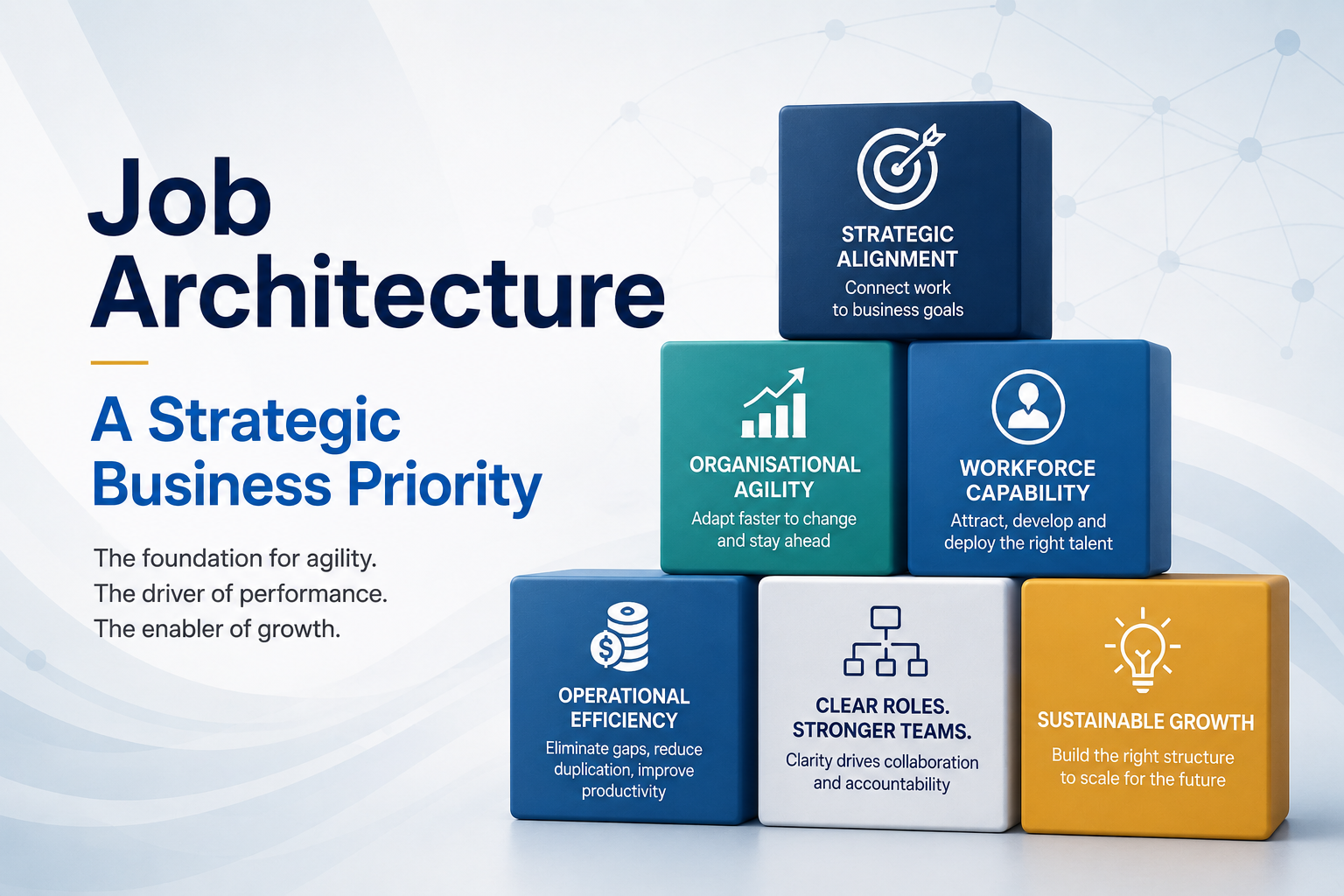
Why Job Architecture Has Become a Strategic Business Priority
Why Job Architecture Matters More Than Ever
For many organisations, job architecture has traditionally been viewed as an administrative HR exercise. It has been used to organise roles, establish career levels and provide structure for remuneration frameworks. While these remain important functions, the role of job architecture has expanded considerably in recent years.
Today's organisations operate in an environment characterised by rapid technological change, evolving workforce expectations, skills shortages and increasing demands for transparency. Business models are changing faster than organisational structures can often keep pace. New roles emerge, responsibilities evolve and traditional career pathways become less linear. In this environment, organisations need a consistent framework that allows them to understand the work being performed, how different roles relate to one another and how decisions regarding progression, remuneration and workforce planning should be made.
Job architecture provides that framework.
Rather than simply classifying jobs, it creates a common organisational language that connects people, work and business strategy. It enables leaders to make more consistent decisions, supports workforce planning and provides employees with greater clarity regarding career opportunities and expectations. Increasingly, it is becoming one of the foundational capabilities that enables organisations to respond confidently to change.
From Administrative Tool to Strategic Capability
Historically, many organisations invested in job architecture only when required to support salary structures or large-scale HR transformation projects. Outside these initiatives, job descriptions were updated infrequently, grading frameworks evolved organically and new positions were often created in response to immediate operational needs.
This approach was sufficient when organisational structures changed relatively slowly. However, today's workforce is significantly more dynamic. Digital transformation, hybrid working, automation, artificial intelligence and changing customer expectations have accelerated the pace at which organisations redesign work.
As responsibilities evolve, organisations need confidence that similar work is recognised consistently across departments and locations. Without a structured job architecture, new roles may be created using inconsistent titles, overlapping responsibilities or different grading approaches, making workforce planning increasingly difficult.
Modern job architecture is therefore no longer simply about documenting roles. It provides the organisational structure that allows businesses to adapt while maintaining consistency, transparency and governance.
Why Organisations Are Revisiting Job Architecture
Several factors are encouraging organisations to review how work is structured.
One of the most significant is the growing importance of workforce transparency. Employees increasingly seek greater clarity regarding career progression, remuneration principles and development opportunities. Organisations are expected to explain not only what employees are paid but also how different roles relate to one another within the broader organisational framework.
At the same time, workforce mobility has increased considerably. Employees move between teams, locations and business units more frequently than in the past. Organisations expanding internationally must also establish consistent approaches across multiple jurisdictions while accommodating local operational requirements.
Technology is another important driver. HR information systems, workforce analytics platforms and AI-enabled talent solutions all depend upon structured organisational data. Inconsistent job titles or fragmented role definitions reduce the quality of workforce insights and limit the effectiveness of digital transformation initiatives.
Together, these developments have shifted job architecture from an HR documentation exercise to a strategic business capability that supports organisational decision-making across multiple functions.
The Business Value Beyond Remuneration
Although job architecture is often associated with pay structures, its value extends far beyond remuneration.
Workforce Planning
Understanding how work is organised enables organisations to identify capability gaps, anticipate future workforce requirements and allocate resources more effectively. Consistent role definitions also improve succession planning by providing greater visibility into organisational capability.
Career Development
Employees are more likely to engage with career development when progression pathways are transparent. Clearly defined job families and career levels help employees understand how roles relate to one another and what capabilities are required for advancement.
Talent Acquisition
Consistent job architecture improves recruitment by establishing standardised role definitions and reducing ambiguity in job advertisements. Recruiters, hiring managers and candidates all benefit from greater clarity regarding responsibilities and expectations.
Learning and Skills Development
As organisations increasingly adopt skills-based approaches to workforce planning, job architecture provides the structure for identifying capability requirements, designing learning pathways and aligning development initiatives with business priorities.
Organisational Design
During restructuring, mergers or business expansion, a well-developed job architecture allows organisations to compare roles objectively, reduce duplication and integrate teams more effectively.
Rather than serving a single HR function, job architecture becomes a shared organisational asset that supports better decision-making across the employee lifecycle.
Common Signs That Job Architecture Needs Attention
Many organisations assume their job architecture is effective because roles have been documented and grading structures exist. However, several indicators suggest that the framework may no longer reflect how work is actually performed.
Employees performing substantially similar work may hold different job titles across departments.
Job descriptions may have remained unchanged despite significant changes in responsibilities.
Career pathways may be unclear, making it difficult for employees to understand how progression occurs.
Managers may rely on individual interpretation when evaluating roles or making remuneration decisions.
Different business units may apply inconsistent grading practices, creating unnecessary complexity and reducing confidence in organisational fairness.
None of these issues necessarily indicates poor management. They often emerge gradually as organisations grow, introduce new technologies or respond to changing business priorities. Regular review helps ensure that job architecture continues to support the organisation rather than simply reflecting historical structures.
Job Architecture and EU Pay Transparency
The EU Pay Transparency Directive has highlighted the importance of understanding work consistently across the organisation.
While the Directive focuses on principles such as equal pay for equal work or work of equal value, organisations cannot meaningfully assess these principles without first understanding how roles relate to one another. Job architecture provides much of the organisational context needed to support this assessment.
A consistent framework for job families, career levels and role definitions helps organisations evaluate positions more objectively, identify comparable work and strengthen the governance surrounding remuneration decisions. It also supports documentation by providing a structured basis for explaining how roles have been classified and how remuneration frameworks have been developed.
Importantly, this does not mean organisations require a perfect or highly complex job architecture before beginning their pay transparency journey. Rather, they should seek a framework that is sufficiently robust, consistent and well-governed to support objective decision-making as organisational needs evolve.
Building a Scalable Job Architecture
Developing an effective job architecture is not about creating the largest possible library of job descriptions. It is about designing a framework that can evolve alongside the organisation.
Successful organisations typically focus on several core principles.
They establish consistent job families that group related work together while recognising functional differences.
They define career levels using objective criteria that reflect increasing responsibility, complexity and organisational impact rather than individual performance.
They maintain job descriptions that describe the purpose and scope of roles without becoming overly prescriptive.
They integrate job architecture with workforce planning, remuneration governance and talent development rather than managing each area independently.
Finally, they review their framework periodically to ensure that organisational changes, emerging technologies and evolving business priorities continue to be reflected appropriately.
Scalability is achieved through consistency rather than complexity.
Looking Beyond Compliance
Although regulatory developments have encouraged renewed interest in job architecture, its strategic importance extends well beyond compliance.
Organisations with strong job architecture are often better positioned to manage workforce transformation, support internal mobility, improve talent retention and make more consistent remuneration decisions. They gain greater visibility into organisational capability while providing employees with increased transparency regarding roles, expectations and career opportunities.
As organisations continue adapting to technological change, evolving workforce expectations and increasingly data-driven decision-making, understanding work consistently becomes a competitive advantage rather than simply an administrative requirement.
Viewed in this context, job architecture is no longer just an HR framework.
It is an organisational capability that supports better business decisions.
Key Takeaways
- Job architecture provides a consistent framework for understanding work across the organisation.
- Its value extends beyond remuneration to workforce planning, talent acquisition, career development and organisational design.
- Inconsistent role definitions can affect governance, analytics, workforce planning and transparency.
- The EU Pay Transparency Directive has reinforced the importance of structured job architecture, but its benefits extend well beyond regulatory compliance.
- Effective job architecture should evolve alongside organisational strategy and support long-term business capability rather than simply documenting existing roles.
Conclusion
The way organisations define work influences almost every aspect of workforce management, from recruitment and career progression to remuneration and organisational planning. As expectations around transparency, governance and workforce agility continue to increase, job architecture has become a strategic capability rather than a purely administrative exercise.
Organisations that invest in consistent, scalable and well-governed job architecture are better equipped to adapt to change, support informed decision-making and build greater confidence in their workforce practices. While there is no single model that suits every organisation, establishing a structured framework for understanding work provides a strong foundation for both operational excellence and long-term organisational resilience.
References & Further Reading
-Directive (EU) 2023/970 on strengthening the application of the principle of equal pay for equal work or work of equal value through pay transparency and enforcement mechanisms.
-European Commission – Equal Pay and Pay Transparency.
-European Institute for Gender Equality (EIGE).
-International Labour Organization (ILO), Equal Remuneration Convention, 1951 (No. 100).
-Society for Human Resource Management (SHRM), Resources on Job Architecture and Workforce Design.
-WorldatWork, Guidance on Job Architecture and Reward Strategy.
About ACEVO
ACEVO helps organisations strengthen workforce governance through practical, evidence-based consulting and digital solutions. We work with organisations to build robust job architecture, improve workforce data, enhance pay governance and prepare for evolving regulatory and organisational requirements, enabling better decisions that support long-term business growth.