
The EU Pay Transparency Directive has prompted many organisations to review their approach to pay equity, reporting and workforce governance. Initial discussions often focus on specific obligations: salary transparency during recruitment, employee rights to pay information, gender pay gap reporting and the circumstances in which employers may need to undertake a Joint Pay Assessment. These requirements are important, but they represent only the visible outputs of a much larger operational framework.
Organisations that approach the Directive as a reporting exercise may find themselves addressing symptoms rather than underlying processes. Producing a report is one task; having confidence in the data, methodology and decisions behind that report is another entirely.
Successful implementation depends less on reacting to individual compliance obligations and more on building organisational capability.
This means establishing systems, governance structures and decision-making processes that enable employers to answer fundamental questions with confidence.
-Is workforce data complete and reliable?
-Are similar jobs evaluated consistently?
-Can remuneration decisions be explained objectively?
-Is there sufficient documentation to support those decisions?
-Do managers understand how pay decisions should be made?
-Can the organisation respond confidently to employee requests for information?
Answering these questions requires more than policy updates. It requires organisations to strengthen the operational foundations that support pay transparency.
Rather than viewing the Directive as a collection of isolated obligations, employers should consider it an opportunity to assess the maturity of their people, reward and governance practices.
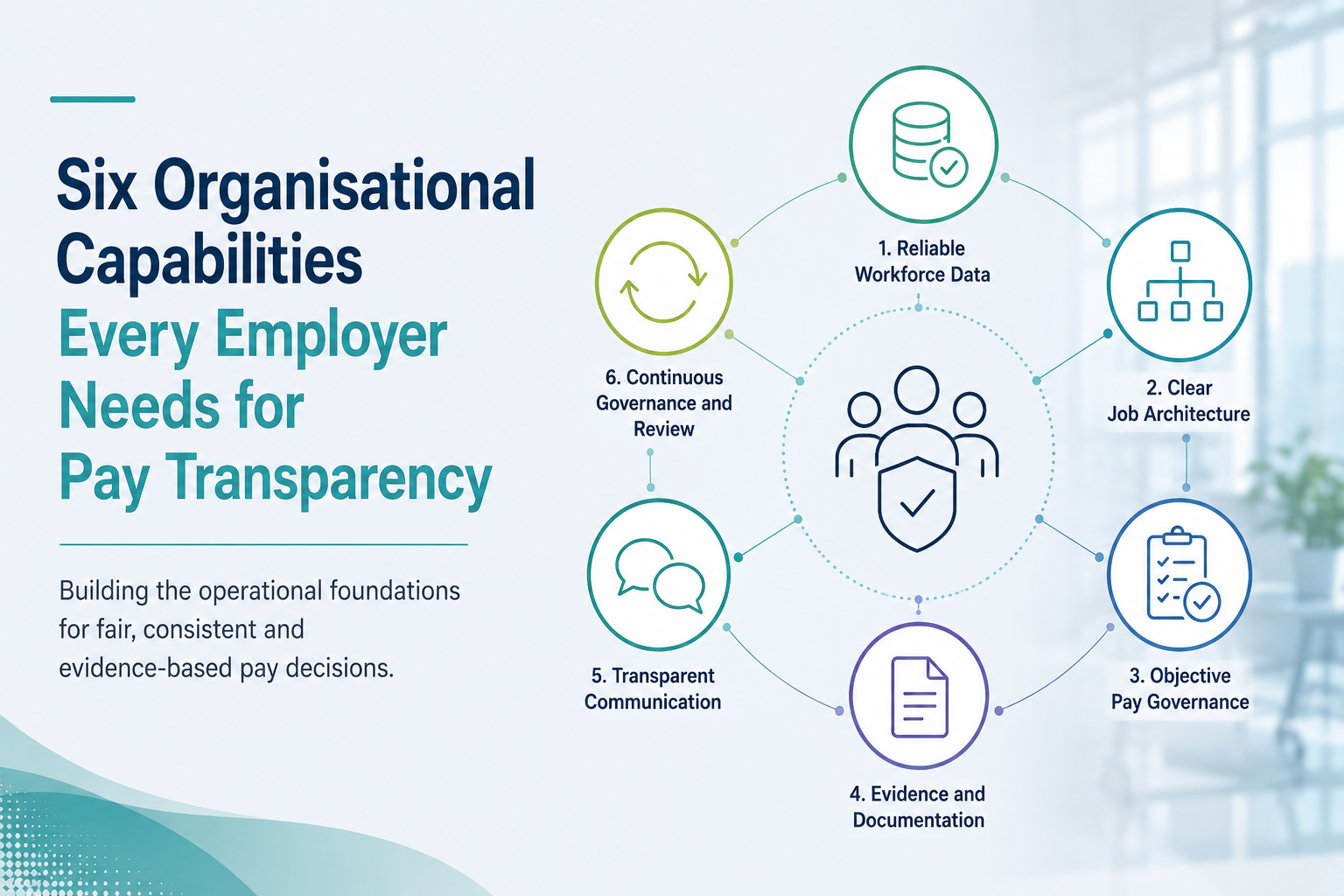
The six capabilities discussed below provide a practical framework for doing exactly that.
Capability One: Reliable Workforce Data
Every pay transparency obligation begins with data.
Whether organisations are analysing gender pay gaps, reviewing remuneration decisions or responding to employee information requests, the quality of the outcome depends entirely on the quality of the underlying data.
Many organisations already maintain extensive HR and payroll information. However, preparing for pay transparency often reveals inconsistencies that have accumulated over time.
Examples include:
- Different job titles being used for similar roles.
- Missing information on bonuses or variable pay.
- Inconsistent department structures.
- Employees assigned to outdated grades.
- Different payroll systems across business units.
- Historical records that are incomplete or difficult to reconcile.
These issues rarely affect day-to-day payroll processing, but they become much more significant when organisations need to produce consistent and comparable analyses.
Reliable workforce data is not simply about accuracy. It is also about consistency.
For example, if one business unit classifies a role as "Senior Analyst" while another uses "Lead Analyst" for substantially the same responsibilities, meaningful comparisons become more difficult.
Similarly, inconsistent recording of allowances, benefits or bonus payments may distort reporting outcomes.
Preparing for pay transparency therefore provides an opportunity to review workforce data more broadly. Many organisations discover that improving data quality also supports workforce planning, budgeting, organisational design and succession planning.
In that sense, better data delivers value well beyond regulatory compliance.
Capability Two: A Clear Job Architecture
Reliable data explains who works within the organisation.
Job architecture explains how work is organised.
Without a structured job architecture, organisations often struggle to demonstrate why different roles occupy different grades or attract different levels of remuneration.
As discussed in our previous article on Understanding Work of Equal Value Under the EU Pay Transparency Directive, job titles alone are not reliable indicators of organisational value.
Instead, organisations need a consistent framework for understanding how different roles relate to one another.
A well-developed job architecture typically defines:
- Job families.
- Career levels.
- Reporting relationships.
- Typical responsibilities.
- Expected competencies.
- Progression pathways.
This creates greater consistency across recruitment, remuneration, promotion and workforce planning. It also provides a stronger foundation for evaluating work objectively.
For organisations that have grown rapidly or expanded through acquisition, reviewing job architecture can uncover overlapping roles, inconsistent grading practices and duplicated career pathways. Addressing these issues often improves organisational clarity while also supporting future compliance efforts.
Most importantly, job architecture creates a common language for discussing work across different parts of the organisation. Without that common language, consistent evaluation becomes considerably more difficult.
Capability Three: Objective Pay Governance
Pay transparency ultimately depends on trust.
Employees are unlikely to view remuneration systems as fair simply because salary data has been published.
Confidence is built when organisations can demonstrate that pay decisions are based on objective, consistent and well-understood principles.
This is where pay governance becomes critical.
Pay governance refers to the policies, decision-making processes and oversight mechanisms that guide how remuneration decisions are made.
Questions worth considering include:
- Who approves starting salaries?
- How are pay increases determined?
- What factors influence bonus decisions?
- How are market adjustments applied?
- When are exceptions permitted?
- Who reviews decisions that fall outside established guidelines?
Without clear governance, remuneration practices can gradually become inconsistent.
Individual managers may apply different standards.
Business units may develop local practices that differ from organisational policy.
Historical decisions may continue simply because they have never been reviewed.
Objective governance reduces these risks by establishing clear decision-making frameworks.
Importantly, objective governance does not remove management discretion. Rather, it ensures that discretion is exercised consistently and supported by documented reasoning.
That distinction becomes increasingly important in a more transparent pay environment.
Capability Four: Evidence and Documentation
One of the recurring themes throughout the EU Pay Transparency Directive is the importance of evidence.
Data demonstrates outcomes.
Documentation explains how those outcomes were reached.
Even where remuneration decisions are reasonable, organisations may struggle to defend them if the underlying rationale has not been recorded.
Documentation should therefore be viewed as an operational asset rather than an administrative burden.
It creates continuity when managers change.
It supports consistency across departments.
It provides context for future reviews.
It also enables organisations to respond more confidently when employees request information or when regulators seek additional explanation.
Good documentation does not require lengthy reports for every pay decision.
Instead, it focuses on maintaining sufficient evidence to explain significant decisions when required.
Examples include documented job evaluations, records of grading decisions, remuneration committee approvals, market benchmarking exercises and the rationale for exceptions to established salary ranges.
Over time, this evidence creates an organisational memory that supports both governance and transparency.## Capability Five: Transparent Communication
Policies and processes are only effective if people understand them.
One of the most significant shifts introduced by the EU Pay Transparency Directive is that conversations about pay are likely to become more frequent. Employees will have greater visibility into remuneration practices, stronger rights to request information and higher expectations of transparency from their employers.
This makes communication an organisational capability rather than simply a change management activity.
Many organisations have traditionally treated pay as a confidential topic discussed only during recruitment or performance reviews. Greater transparency requires a different approach.
Managers should understand not only what decisions have been made, but why they have been made.
Employees should understand how roles are evaluated, how salary ranges are established and which objective factors may influence pay progression.
Clear communication helps reduce misunderstanding.
It also improves confidence in organisational processes, particularly when employees understand that remuneration decisions are supported by consistent evaluation criteria rather than individual judgement.
Effective communication should not begin once reporting obligations take effect. It should form part of broader organisational readiness.
Questions employers may wish to consider include:
- Do managers understand the organisation's pay philosophy?
- Can managers explain how starting salaries are determined?
- Are employees aware of how job grades or career levels are structured?
- Is there a consistent process for responding to questions about remuneration?
- Have HR and leadership teams agreed on key messages regarding pay transparency?
Preparing managers for these conversations may become just as important as preparing payroll systems.
Capability Six: Continuous Governance and Review
Pay transparency should not be viewed as a one-time implementation project.
Organisations change continuously.
New roles are created.
Business priorities evolve.
Technology reshapes responsibilities.
Teams expand into new markets.
Compensation structures adapt to changing labour markets.
As organisations evolve, the assumptions underpinning job evaluations and remuneration decisions also need periodic review.
This is why governance should be viewed as an ongoing capability rather than a fixed framework.
Regular reviews allow organisations to identify inconsistencies before they become embedded within remuneration practices.
Examples of ongoing governance activities include:
- Reviewing job evaluation outcomes following organisational restructuring.
- Monitoring changes in workforce composition.
- Assessing whether grading decisions remain consistent across departments.
- Evaluating trends identified through gender pay gap analysis.
- Reviewing exceptions granted outside established salary ranges.
- Updating documentation following significant organisational changes.
Continuous review also supports organisational learning.
Each reporting cycle provides an opportunity to improve data quality, strengthen governance processes and refine communication strategies.
Employers that embed regular review into existing governance structures are likely to find future compliance significantly more manageable than organisations that approach pay transparency as a periodic reporting exercise.
Bringing the Six Capabilities Together
Each capability discussed in this article supports the others.
Reliable workforce data improves reporting accuracy.
Clear job architecture strengthens work of equal value assessments.
Objective governance supports consistent remuneration decisions.
Documentation provides evidence behind those decisions.
Transparent communication builds trust across the organisation.
Continuous review ensures that governance remains effective as the organisation evolves.
None of these capabilities operates in isolation.
Organisations that focus exclusively on reporting technology may still struggle if job architecture is inconsistent.
Those with robust grading structures may encounter difficulties if documentation is incomplete.
Similarly, well-designed governance processes deliver limited value if managers are unable to communicate them confidently.
Successful implementation therefore depends on viewing pay transparency as an organisational capability rather than a compliance checklist.
Key Takeaways
- Pay transparency requires operational capability as well as regulatory understanding.
- Reliable workforce data forms the foundation of every reporting and governance activity.
- Clear job architecture supports consistent evaluation of work across the organisation.
- Objective governance helps ensure remuneration decisions are fair, transparent and defensible.
- Documentation creates the evidence needed to explain significant pay decisions.
- Effective communication prepares managers and employees for greater transparency.
- Continuous governance enables organisations to adapt as roles, structures and regulatory expectations evolve.
Conclusion
The EU Pay Transparency Directive introduces new obligations, but its longer-term impact extends beyond compliance.
For many organisations, implementation will prompt a broader review of how work is organised, how remuneration decisions are made and how those decisions are supported by evidence.
The organisations that respond most effectively are unlikely to be those that simply prepare for the next reporting deadline.
Instead, they will be those that invest in the underlying capabilities that support consistent decision-making.
Reliable data.
Clear job architecture.
Objective governance.
Strong documentation.
Transparent communication.
Continuous review.
Together, these capabilities create a stronger foundation not only for regulatory readiness but also for better workforce management.
Pay transparency should therefore be viewed not as a standalone compliance initiative, but as an opportunity to strengthen organisational governance in a way that supports fairness, consistency and long-term business resilience.
References & Further Reading
- Directive (EU) 2023/970 on strengthening the application of the principle of equal pay through pay transparency and enforcement mechanisms
- European Commission – Equal Pay and Pay Transparency
- European Institute for Gender Equality (EIGE)
- ILO Equal Remuneration Convention, 1951 (No. 100)
About ACEVO
ACEVO helps organisations prepare for the operational realities of the EU Pay Transparency Directive through practical, evidence-based workforce governance solutions.
Our approach combines workforce data analysis, job evaluation, reporting, governance and documentation to help employers build transparent and defensible remuneration practices.
Rather than focusing solely on compliance, we help organisations strengthen the operational foundations that support fair, consistent and sustainable people decisions.