
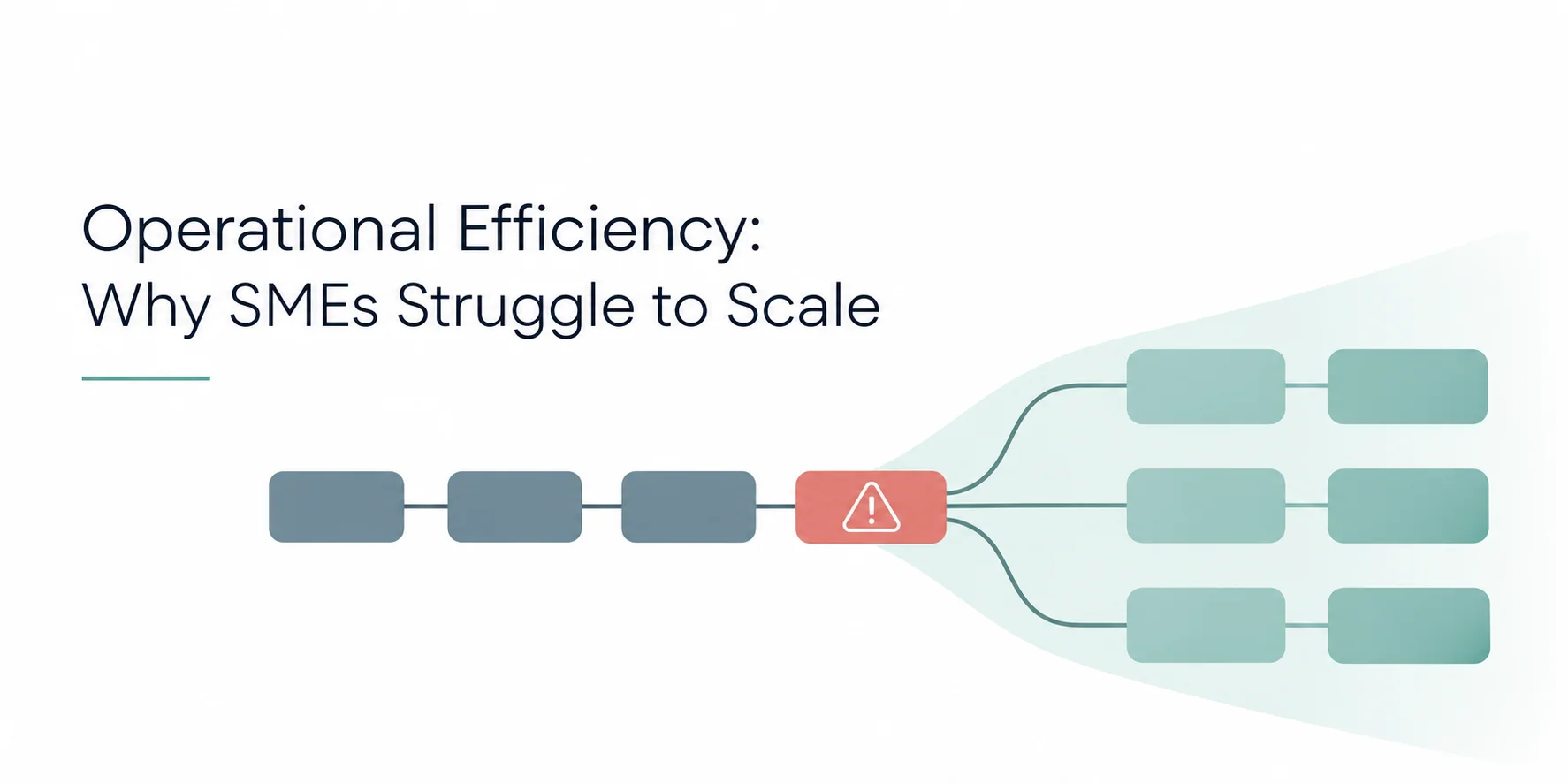
Growth is usually interpreted as evidence that a business is doing something right. More customers, larger contracts, new markets and expanding teams suggest that the organisation has established a proposition worth investing in.
Yet growth can expose weaknesses that were almost invisible when the business was smaller.
A customer request that once took a few hours to resolve begins moving between departments. A routine approval requires input from several managers. Financial reporting takes longer, even though the business has invested in additional software. Senior leaders find themselves increasingly involved in operational decisions that should have been resolved elsewhere.
Revenue may be growing, but the organisation is becoming more difficult to run.
For small and medium-sized enterprises (SMEs), this presents a fundamental management challenge: how can a business increase its capacity without allowing operating costs, coordination requirements and organisational complexity to grow at the same rate?
The answer depends on more than hiring additional employees or adopting new technology. It requires an understanding of how work moves through the organisation, where decisions are made and which management practices support consistent performance.
Growth and scalability are different measures of success
A business can grow without becoming more scalable.
Growth describes an increase in activity or output: more sales, customers, employees or revenue. Scalability concerns the organisation's ability to accommodate that increase without a proportionate rise in the resources required to deliver it.
Consider two professional services firms experiencing similar revenue growth.
The first responds by hiring more coordinators, adding management layers and creating separate tracking systems for each department. The second standardises recurring workflows, clarifies decision-making authority and improves the information available to its teams.
Both businesses may achieve their immediate commercial objectives. Their longer-term economics, however, could be quite different.
The first may become increasingly dependent on additional headcount to manage complexity. The second may be able to support a larger volume of work with a more controlled increase in costs.
Neither model is automatically superior. Some services are inherently labour-intensive, and growth can legitimately require more specialist capacity. The important distinction is whether additional resources are creating customer value or compensating for avoidable operational inefficiencies.
For management teams, this changes the question from "How many more people do we need?" to "What is preventing our existing operating model from handling more work effectively?"
What research tells us about operational performance
The relationship between management practices and business performance has been examined extensively.
Research by Nicholas Bloom, John Van Reenen and colleagues, drawing on the World Management Survey, found substantial differences in management quality across firms and countries. Their work connects practices such as performance monitoring, target-setting and operational management with differences in productivity and organisational outcomes.
A study published in The Quarterly Journal of Economics in 2007, examining 732 medium-sized firms across the United States, France, Germany and the United Kingdom, found that stronger management practices were associated with higher productivity, profitability and business survival.
The research does not suggest that every business should adopt an identical management structure. It does, however, challenge the assumption that operational performance is determined primarily by market conditions, technology investment or workforce size.
How a business is managed matters.
The OECD's 2025 report, SME Digitalisation for Competitiveness, provides another relevant perspective. It examines how SMEs derive value from digital technologies and identifies the adaptation of business processes as an important part of successful digitalisation.
This distinction is significant. A business may purchase capable software without improving the underlying process. In that situation, the technology can make existing activities faster while leaving duplication, unclear responsibilities and unnecessary approvals largely untouched.
Operational efficiency therefore needs to be examined as a management issue before it becomes a technology procurement exercise.
1. The cost of work that nobody measures
Most businesses monitor revenue, payroll, major expenses and project profitability. Far fewer have a clear picture of the time consumed by internal coordination.
That time can be substantial.
Employees may spend hours locating the latest version of a document, reconciling information between systems, checking the status of requests or following up on approvals.
Individually, these activities appear minor. Across an organisation, they can consume capacity that would otherwise support customers, delivery or business development.
Consider an illustrative example.
A 40-person services company has 20 employees who each spend an average of three hours per week on avoidable administrative rework.
That represents:
- 60 employee-hours per week
- Approximately 3,000 hours across 50 working weeks
- The equivalent of roughly 1.6 full-time working years, assuming 1,875 productive hours per employee annually
These figures are illustrative, not an industry benchmark. They also do not imply that all the time could be recovered or converted into financial savings.
They demonstrate why apparently small process problems deserve management attention.
Before investing in a new system, businesses should identify where employees are spending time on activities that do not improve the quality, speed or reliability of the final outcome.
Useful questions include:
- How often is information entered more than once?
- Which activities regularly require correction or clarification?
- How much time passes between completing a task and receiving the next approval?
- Where do employees depend on informal follow-ups to keep work moving?
- Which reports require manual consolidation every month?
The purpose is not to measure every employee's activity. It is to identify recurring friction in the way work is organised.
2. Decision-making becomes a bottleneck
In the early stages of a business, centralised decision-making can be an advantage.
Founders have direct knowledge of customers, products, finances and employees. They can respond quickly without extensive consultation or formal approval processes.
As the business grows, that same arrangement can become a constraint.
Managers may be responsible for delivering outcomes but lack the authority to approve routine decisions. Employees may seek confirmation from senior leadership because responsibilities are unclear. Decisions that should take hours begin taking days.
The organisation becomes dependent on a small number of individuals.
This is particularly visible in businesses where founders remain involved in pricing exceptions, project staffing, procurement, customer escalations and operational scheduling.
Founder involvement is valuable when decisions have strategic implications. It becomes inefficient when leadership attention is consumed by matters that could be governed through agreed policies and decision thresholds.
A more scalable operating model distinguishes between:
Routine decisions: Matters that teams can resolve independently within established parameters.
Exception decisions: Situations requiring additional review because they fall outside normal commercial or operational limits.
Strategic decisions: Choices involving material investment, significant risk or changes to the organisation's direction.
For example, a project manager might be authorised to approve expenditure within an agreed budget, while changes that materially affect profitability require leadership approval.
This preserves control without making every decision dependent on senior management.
The objective is not decentralisation for its own sake. It is to ensure that decision-making authority reflects responsibility, risk and the information required to make a sound judgement.
3. Processes designed for ten employees rarely work for fifty
Many SMEs develop their operating procedures organically.
A spreadsheet is created to manage customer enquiries. Another tracks project delivery. A shared folder stores contracts. Finance maintains a separate record of invoices, while managers use email or messaging applications to monitor outstanding work.
These arrangements may be entirely appropriate when the business is small.
Problems arise when the organisation continues using them despite substantial changes in transaction volume, workforce size or service complexity.
An expanding business introduces more handovers, dependencies and exceptions. Work that previously relied on direct conversations now requires coordination between people who may not work closely together.
Without clear process design, three problems commonly emerge.
Unclear ownership
Several employees may participate in a workflow, but nobody has responsibility for its end-to-end performance.
A customer onboarding process, for example, may involve sales, finance, operations and service delivery. Each department completes its assigned activity, yet no single person is accountable for whether the customer is fully onboarded within the agreed timeframe.
Inconsistent execution
Different employees may handle the same task differently.
Variation is not necessarily undesirable. Complex customer situations often require professional judgement. However, unnecessary variation in routine activities increases training requirements, makes performance harder to compare and can produce inconsistent customer experiences.
Weak exception handling
Processes may work under normal conditions but fail when something unexpected happens.
An incomplete customer document, delayed supplier response or unusual commercial requirement can trigger repeated emails and improvised decisions because no clear escalation route exists.
For growing SMEs, process improvement should therefore focus on the entire workflow rather than individual departmental tasks.
A department can appear efficient while the overall customer journey remains slow.
4. Technology investment does not guarantee productivity
Digital tools can improve operational efficiency, particularly when they reduce manual work, make information more accessible and support better coordination.
However, software adoption and operational improvement are not interchangeable.
The OECD identifies persistent gaps between SMEs and larger firms in the adoption of more sophisticated technologies, including integrated enterprise systems and advanced data capabilities. It also highlights limited resources, skills shortages and financial constraints as barriers to digitalisation.
These findings help explain why technology decisions can be difficult for smaller businesses.
An SME may recognise that its systems are inadequate while lacking the internal capacity to evaluate alternatives, manage implementation or redesign the affected workflows.
The result can be incremental technology purchasing without an overall operating model.
For example, a company may introduce a customer relationship management platform but continue maintaining a separate sales spreadsheet because employees do not trust the information in the new system.
Alternatively, a project management application may provide detailed task tracking while resource allocation remains dependent on informal discussions.
In both situations, the technology exists, but the organisation has not established a reliable way of using it.
The central question should be:
Which operational problem will this technology solve, and how will we measure the improvement?
A useful technology business case should identify the existing process, the expected change, the employees affected and the measurable outcome.
Potential measures include reduced processing time, fewer errors, improved visibility of work in progress or faster customer response.
Businesses should also consider integration requirements, data ownership, access controls, training and ongoing maintenance.
For some SMEs, a relatively simple configuration of existing tools may deliver greater value than a large software implementation.
The appropriate solution depends on operational requirements, not the sophistication of the technology.
5. Management information often arrives too late
As organisations grow, leaders need reliable information to understand performance and allocate resources.
Yet management reporting frequently becomes more complicated at precisely the point when better visibility is required.
Different departments may maintain separate definitions of revenue, project completion, customer status or resource utilisation.
Reports are assembled manually. Figures require reconciliation. By the time management receives a consolidated view, the information may already be outdated.
This creates a gap between operational activity and management decisions.
A business may know its monthly revenue but struggle to identify which projects are consuming more resources than expected. It may track the number of customer enquiries without understanding how many are delayed during onboarding.
The solution is not necessarily more dashboards.
It is agreement on a limited set of meaningful measures, consistent definitions and clear ownership of the underlying information.
For a growing services business, these might include:
| Operational area | Useful measure | Management question |
|---|---|---|
| Customer onboarding | Median time from contract to activation | Where are customers waiting? |
| Project delivery | Percentage of milestones completed on schedule | Are delivery commitments realistic? |
| Resource planning | Planned versus actual capacity | Where are teams overextended? |
| Financial control | Project margin variance | Which types of work are becoming less profitable? |
| Service quality | Rework or repeat-issue rate | What is reducing delivery quality? |
| Cash management | Average collection period | Is growth placing pressure on working capital? |
The measures should reflect the business model. A manufacturing SME will require different operational indicators from a professional services firm or digital platform provider.
What matters is whether the information helps managers make timely decisions.
Reporting that does not influence action has limited operational value.
6. Standardisation should not eliminate flexibility
A common concern about process improvement is that it introduces bureaucracy.
For smaller businesses, flexibility and responsiveness are often competitive advantages. Excessive standardisation can undermine those strengths.
The challenge is to determine which activities benefit from consistency and which require discretion.
Routine administrative tasks, information capture, approval thresholds and compliance controls are often suitable for standardisation.
Customer problem-solving, specialist advisory work and complex commercial negotiations may require greater flexibility.
An effective operating model makes this distinction explicit.
It establishes a consistent foundation for recurring work while allowing employees to exercise judgement when circumstances justify a different approach.
This can also improve employee experience.
Clear responsibilities reduce uncertainty. Reliable information reduces repeated follow-ups. Well-designed escalation processes help employees resolve issues without waiting for unnecessary approvals.
Operational efficiency should therefore be assessed partly through the experience of the people carrying out the work.
If a new process improves management reporting but significantly increases the administrative burden on employees, its overall value deserves closer examination.
7. Why hiring more people may not solve the problem
Recruitment is often the most immediate response to increasing workloads.
Sometimes it is unquestionably necessary. A growing business needs sufficient capacity and specialist expertise to deliver its commitments.
But hiring can also conceal weaknesses in process design.
If a workflow requires repeated manual reconciliation, adding another employee may increase throughput without addressing the underlying cause.
If managers spend substantial time approving routine decisions, creating another management position may simply introduce an additional approval layer.
Before expanding headcount, leaders should examine the source of the workload.
Is demand increasing because the business is serving more customers? Or because existing processes generate avoidable work?
The distinction matters for workforce planning.
Where additional capacity is genuinely required, recruitment should proceed. Where workload is driven by duplication, unclear responsibilities or poor information flow, process improvement may offer a more sustainable response.
In many cases, businesses need both.
The aim is to ensure that new employees increase the organisation's productive capacity rather than become absorbed into managing existing inefficiencies.
8. A practical operational-efficiency review for SMEs
Improving operational efficiency does not require an organisation-wide transformation programme.
A focused review of one important workflow can provide a useful starting point.
Step 1: Select a process with commercial significance
Choose a workflow that affects revenue, customer experience, delivery performance or operating costs.
Examples include customer onboarding, proposal approval, project mobilisation, procurement or invoicing.
Avoid beginning with a process simply because it is easy to document. Select one where improvement would have a meaningful business impact.
Step 2: Map how the work actually happens
Document the process as employees perform it, including informal steps and workarounds.
Identify who initiates the work, which information is required, where handovers occur and who approves exceptions.
The documented procedure may differ considerably from everyday practice.
Step 3: Establish a baseline
Measure the current performance of the workflow.
Depending on the process, this may include total completion time, waiting time, error rates, rework, manual effort or customer complaints.
Distinguish between the time employees actively spend completing tasks and the time work remains idle between stages.
A process that takes five days to complete may involve only a few hours of actual work.
Step 4: Identify the causes of delay
Examine recurring problems rather than isolated incidents.
Are approvals unclear? Is information incomplete at the start? Do employees maintain duplicate records? Does work frequently return to an earlier stage for correction?
Ask employees who perform the work to explain why these problems occur.
Step 5: Redesign before automating
Remove unnecessary activities, clarify ownership and simplify decision-making.
Only then assess whether technology can support the revised workflow.
Automating an inefficient process may improve its speed without improving its underlying logic.
Step 6: Test and measure the improvement
Pilot the revised process with a manageable group or limited transaction volume.
Compare results against the baseline.
For example, an organisation might aim to reduce median onboarding time from eight working days to five while maintaining service quality.
That is a hypothetical target, not an expected industry result.
The organisation should establish its own targets based on operational requirements and available evidence.
Step 7: Assign continuing ownership
A process improvement is unlikely to remain effective without accountability.
Assign an owner responsible for monitoring performance, reviewing exceptions and coordinating future changes.
Operational improvement should become part of regular management practice rather than an isolated project.
9. Operational efficiency is also a leadership responsibility
Process design, technology and performance measures are important, but they depend on management behaviour.
Employees are unlikely to follow a new approval framework if senior leaders routinely bypass it. Data quality will remain inconsistent if managers continue requesting separate spreadsheets instead of using agreed systems.
Similarly, attempts to reduce unnecessary work will have limited effect if teams are rewarded primarily for activity rather than outcomes.
Research on management practices reinforces the importance of consistent operational routines, meaningful performance monitoring and appropriate incentives.
For SME leadership teams, this means treating operational efficiency as an ongoing management discipline.
Regular reviews should consider where work is slowing, which decisions are repeatedly escalated and whether existing processes remain appropriate as the business changes.
The objective is to identify problems before they become embedded in the organisation's cost structure.
10. Scaling requires an operating model that can evolve
There is no single operating model suitable for every growing SME.
A business expanding into new markets may need stronger financial controls and more formal governance. A professional services firm may prioritise resource planning and project profitability. A technology business may need to strengthen product delivery, customer support and information security.
The relevant operational priorities will change as the organisation develops.
What should remain consistent is the discipline of examining how work is performed and whether the operating model continues to support the business's commercial objectives.
Growth creates new demands. Processes that were appropriate two years earlier may no longer be sufficient.
Recognising this is not evidence of management failure. It is a normal consequence of organisational development.
The risk arises when businesses continue adding employees, tools and reporting requirements without reviewing the structures connecting them.
Conclusion: Better operations create room for growth
For SMEs, operational efficiency is closely connected to profitability, customer experience and the ability to pursue new opportunities.
Businesses with reliable processes and clear decision-making structures can devote more management attention to customers, innovation and strategic development.
Those with fragmented workflows and weak operational visibility may find that increasing activity creates disproportionate pressure on employees, costs and leadership capacity.
The priority is not to make every activity faster or eliminate every variation.
It is to understand where the organisation creates value, where resources are being consumed unnecessarily and how its operating model can support the next stage of growth.
A scalable business is one that can take on greater complexity without allowing that complexity to dictate how the entire organisation operates.
For growing SMEs, building that capability is a practical management priority.
References
-
OECD (2025). SME Digitalisation for Competitiveness: The 2025 OECD D4SME Survey. OECD SME and Entrepreneurship Papers, No. 68.
-
OECD (2023). OECD SME and Entrepreneurship Outlook 2023. OECD Publishing.
-
Bloom, N. and Van Reenen, J. (2007). Measuring and Explaining Management Practices Across Firms and Countries. The Quarterly Journal of Economics, 122(4), 1351–1408.
-
Bloom, N., Sadun, R. and Van Reenen, J. (2016). Management as a Technology?. NBER Working Paper No. 22327.
-
Scur, D., Sadun, R., Van Reenen, J., Lemos, R. and Bloom, N. (2021). The World Management Survey at 18: Lessons and the Way Forward. NBER Working Paper No. 28524.
About ACEVO Global Advisory
ACEVO Global Advisory works with growing businesses on strategy, technology and operational improvement. Our approach connects business requirements with practical implementation, helping organisations strengthen processes, improve decision-making and develop systems that support sustainable growth.